
Working-Class Democracy In Action
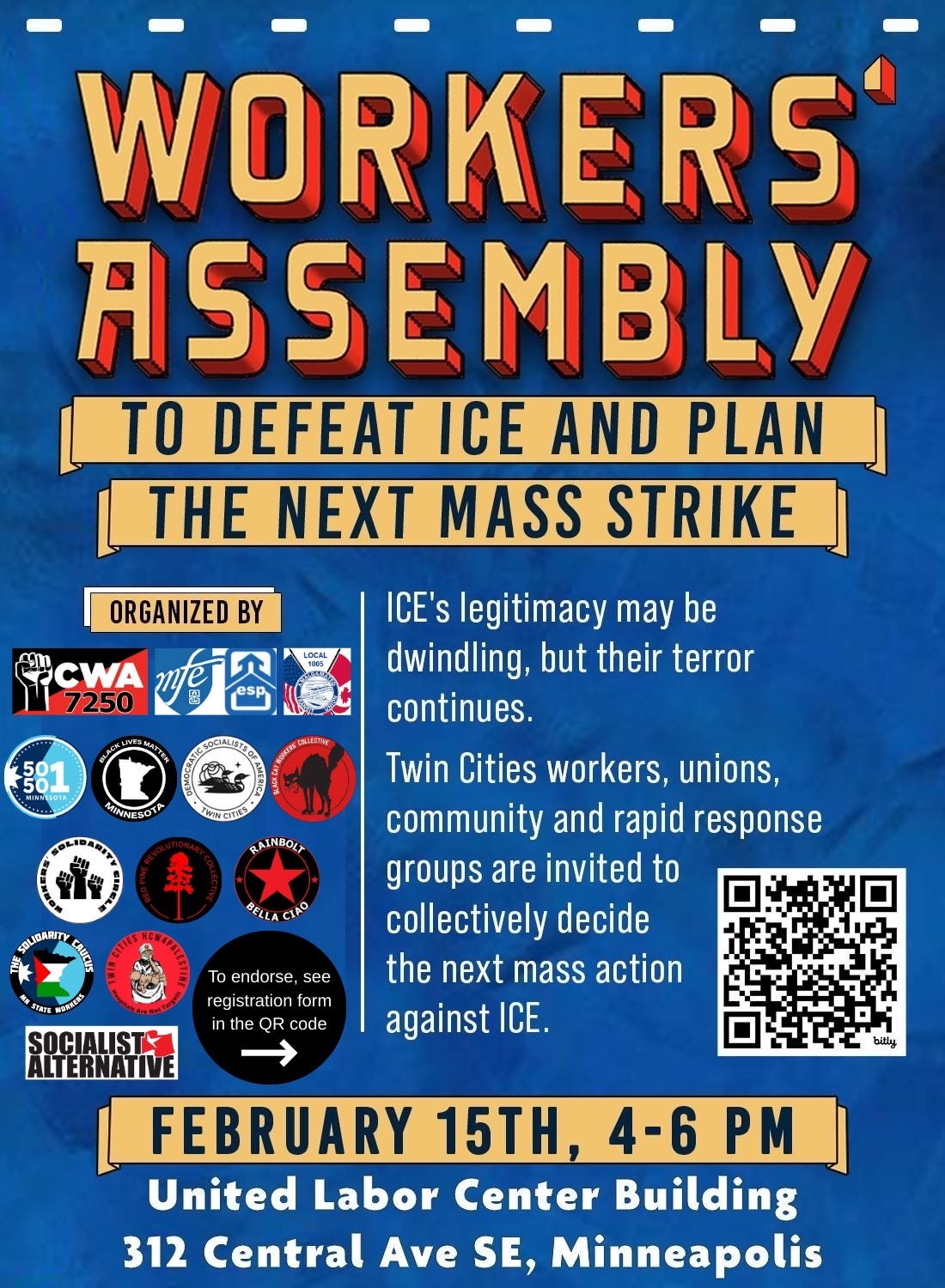
Born out of the crucible of an armed occupation of the Twin Cities by ICE, the abduction of thousands of Minnesota neighbors and the assassination of Renee Good and Alex Pretti, a remarkable and likely historic mass meeting took place in Minneapolis on Sunday, February 15, 2026. The meeting, entitled “Workers’ Assembly to Defeat ICE and Plan the Next Mass Strike,” drew nearly 400 working-class fighters, more than a dozen different unions, and people from both neighboring and coastal states. Besides members of a variety of syndicalist and socialist groups, a large number of workers who belonged to no group were in attendance.
One remarkable aspect of this meeting was the fact that political organizations that previously had been operating largely apart from and parallel to each other came together to act collectively to fight ICE. That we were stronger together and needed to begin to act as a class across our differences was suddenly evident to everyone in the room. A newfound solidarity was born out of the twofold pressures that had been shaping our mettle: the unrelenting pressure of ICE that we had been resisting together for the past three months and our shared experience on January 23rd of what a mass strike could look like.
Solidarity Forged In Battle
By “resisting together,” we mean the shared experience of waging a defensive campaign against ICE. We’d already been fighting ICE shoulder to shoulder for the past two months in our neighborhoods and in some of our workplaces and unions. We harassed ICE agents with whistles, phone cameras, and shouts of anger. We organized food delivery to feed those who were too afraid to venture outside or go to work because of fear of abduction. We ushered children to and from school and stood guard at those same schools to keep ICE away. We protested the abduction, false arrests, and murders of our neighbors. Solidarity was truly forged in the heat of battle, and it informed the way that we saw each other at the assembly: as fellow fighters in the battle against ICE and fascism across our political differences, neighborhoods, and the U.S.
In the sub-zero temperatures of the Minnesota winter, something else happened that changed the way we saw each other. On January 23rd, eighty thousand Minnesotans marched in the streets of Minneapolis and hundreds of thousands did not show up for work or school across the state. A day of “No Work. No School. No Shopping” had been called across Minnesota by unions, faith communities, and political organizations. One poll showed that 25% of the state’s residents participated in some way. For example, at some worksites 80% of the workers did not show up. At MSP airport, some areas reported 65% absenteeism. And most of the people at the February 15th Workers’ Assembly had played some kind of role in organizing their group or at least participating in the day. The majority of the people in the streets that day believed they were at a protest against ICE, but those at the assembly had glimpsed the potential power of the Twin Cities working class to stop the flow of profits to the corporate class through an even bigger work stoppage.
The assembly on the 15th was on the calendar long before the people of the Twin Cities began taking to the streets en masse to protest ICE’s vicious and murderous assault on our neighbors. The Workers’ Solidarity Circle (WSC), which had already been calling assemblies for the left-wing of the local labor movement since the fall of 2024, had planned the day to be a first step in launching the new hybrid/membership model that the coalition had recently conceived. But the skeleton of an agenda that was waiting to be fleshed out for that meeting was a perfect container to repurpose for this convening of class-struggle unionists, workers, organizations, and neighborhood mutual aid and rapid response groups.
Workers’ Solidarity Circle
Beyond these unique circumstances, it is also important to know a bit about WSC to understand how this united front coalition of nearly 400 people came together.
Workers Solidarity Circle (WSC) emerged from the collaboration between three different political organizations around the SEIU-led 2024 contract compression -- the so-called “Minnesota Miracle.” Twin Cities Democratic Socialists of America, Black Cat Workers Collective, and the Red Pine Revolutionary Collective had been invited to build a labor-left “Solidarity Table” for what was originally intended to be a powerful alignment of contract negotiations (and potential strikes) among dozens of Minnesota unions in March of 2024. With WSC, we committed to revisit that united-front formation in order to actually concentrate the power of the militant, anti-authoritarian, class-struggle wing of the Twin Cities labor movement.
Since fall of 2024, WSC has organized events designed to bring together rank-and-file workers as a way to build community, capacity, and power among the local working class. We have hosted film screenings, socials, and fundraisers; organized and participated in direct actions; supported local strikes, organizing drives and info pickets at worksites such as Delta and Starbucks; and consistently drawn crowds of more than 100 to assemblies about the political concerns of labor, including what’s next for labor in light of rising fascism (December 2024), resisting Trump’s deportation agenda (March 2025), and talking about a general strike (May 2025). Our consistent goal has been to combine the power of our respective organizations to draw more workers into the class struggle.
The February 15th assembly was originally designed to be a meeting for established and newly activated class-struggle activists: workers involved in democratizing their unions, starting a union, or those looking for a place to build collective power to climate change, fascism, or attacks on immigrants. WSC is in the process of transitioning from a coalition to a membership organization, where workers from different unions, industries, community organizations, and neighborhoods can collaborate to make large-scale political change.
The Assembly
One long time union activist described the assembly as “one of the most profoundly democratic meetings” he had ever been to. Another union leader said she wanted to “bottle what had just happened and send it out to cities across the country”. The resolutions passed, mostly by acclamation, were very concrete: build for a May 1 mass strike in Minnesota and create actions that will build support for that. There was a maturity and discipline on the part of the audience, likely born out of the dire circumstances of the last 80 days, that kept the meeting focused and on track. Plans were also made to reach out to unions across the state and build worksite committees and trainings to encourage mass participation in another day of “No Work, No School and No Shopping.”
At the heart of all of this was a deep commitment to democratic functioning. The newly assembled group was able to make decisions together for the benefit of the people, putting the things that normally divide us aside. The challenge now facing organizers and participants is to implement the decisions of the assemblies, and to do so democratically -- in a way that will continue to invite more workers into the conversation and center their potential to lead.
To the surprise of assembly organizers, several out-of-state attendees have already reached out to ask for help in organizing a similar workers’ assembly (toward a May Day action) in their cities. Where conditions are right and democratic, class-struggle coalition-building is possible, workers’ assemblies can be a powerful organizing tool for building rank-and-file power through the labor movement. The time might be right.